Quick Answer
Choose a birth center if you want midwife led care in a space that already has the tub, the equipment, and a clinical team on site, along with an established transfer relationship with a hospital. Choose a planned home birth if staying in your own space matters more to you than being where those resources are kept, and your pregnancy, your home, and your distance from the hospital all support it.
Both options are intended for healthy, uncomplicated pregnancies and are usually attended by midwives. Which one stays available to you can change during pregnancy, so your provider is the person who can tell you what is realistic for your history.
Neither setting is automatically the safer or better choice for every family. A birth center and a planned home birth both offer midwife led care for healthy, uncomplicated pregnancies with fewer routine interventions than a typical hospital birth, so the decision usually comes down to how close you want to be to on site equipment and a clinical team, what your pregnancy and health history allow, how your home and travel logistics actually work, and where you feel most able to relax and labor.
That last part matters more than people expect. Labor tends to progress more easily when a person feels private, unhurried, and safe, and different people find that feeling in very different rooms.
Below is a plain comparison of what each setting offers, what they have in common, who tends to be a candidate for each, and the questions worth asking before you commit.
Key Takeaways
- Both birth centers and planned home births are designed for healthy, uncomplicated pregnancies and are usually attended by midwives, not by physicians managing a medicalized birth.
- The clearest practical differences are location, what equipment and supplies are kept on site, how a hospital transfer would work, and who handles setup and cleanup.
- Birth centers are licensed health care facilities in New York, and many are also accredited nationally, which gives families a way to verify standards before choosing.
- Professional guidance treats candidate selection, a qualified attendant, and a workable transfer plan as the factors that matter most for out of hospital birth outcomes.
- Certain findings, including a breech baby, twins, or a previous cesarean, generally move the conversation toward a hospital birth regardless of setting preference.
- Cost and insurance coverage often differ between the two options, so both deserve a direct conversation with your provider and your plan.
What Is a Birth Center?
A birth center is a health care facility built for childbirth, staffed by midwives, and intentionally not designed like a hospital labor and delivery unit. The Commission for the Accreditation of Birth Centers describes a birth center as a facility where care is provided in the midwifery and wellness model, freestanding and separate from a hospital.
In New York, birth centers operate as licensed facilities. State classification guidance describes a birth center as a licensed center providing birthing services to patients with healthy, uncomplicated pregnancies during pregnancy, labor, and delivery who need a stay of less than 24 hours after birth, with care based on a family centered philosophy that treats pregnancy and birth as a normal physiological process requiring limited technological and pharmacological support. The attending provider at the birth must be a physician or a licensed midwife.
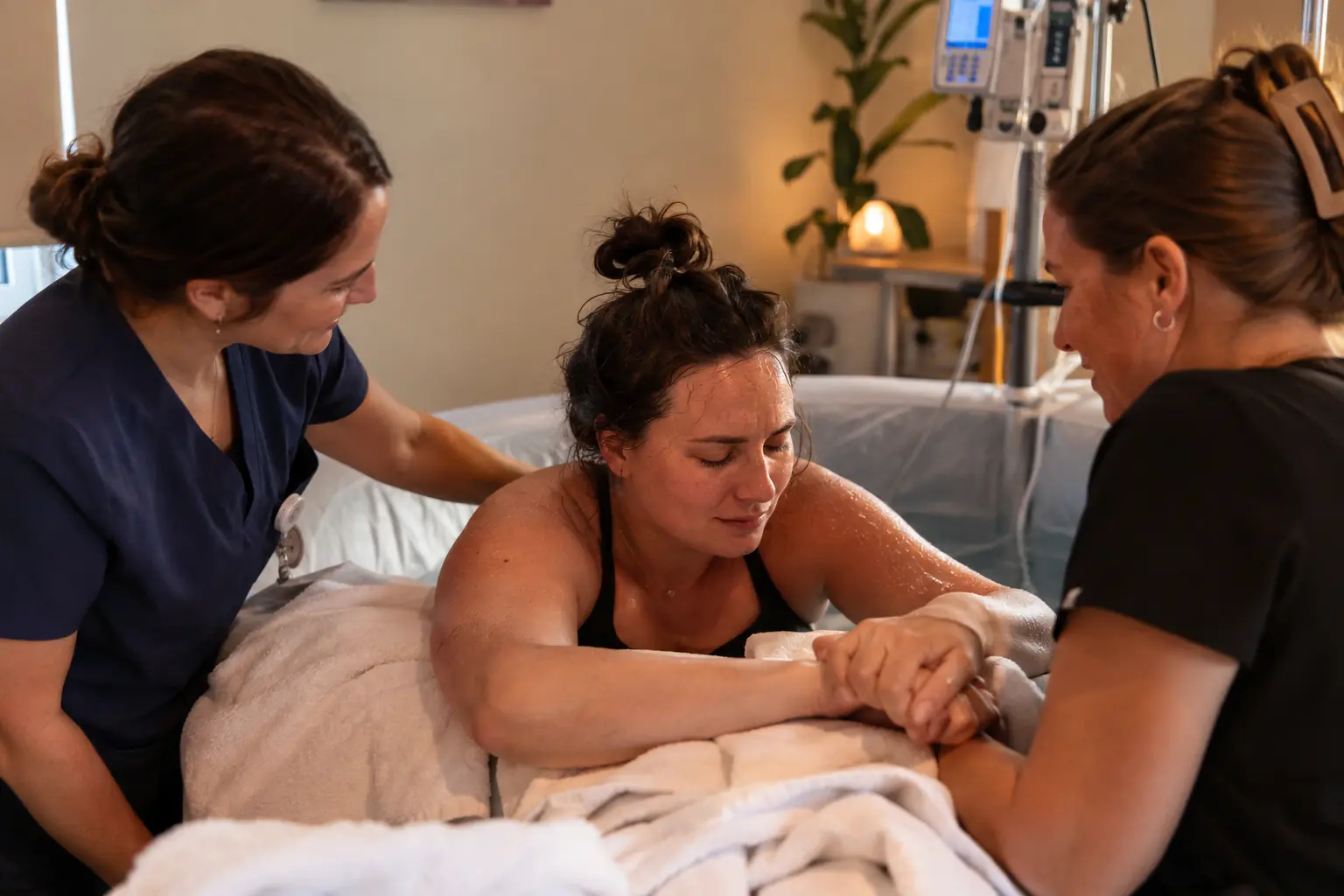
Practically, that means a birth center room usually has a bed, a large tub, birth stools or balls, dimmable lighting, and a private bathroom, while the medical supplies stay in cabinets rather than on display. The center keeps oxygen, newborn resuscitation equipment, IV fluids, antibiotics, medications used to manage postpartum bleeding, and suturing supplies on hand. Epidurals and continuous electronic fetal monitoring are not part of birth center care, which is worth knowing early if pain relief options are important to you. You can read more about what is available for pain relief during labor at a birth center.
Most families go home within several hours of the birth, after both parent and baby have been examined and feeding has been evaluated.
What Is a Planned Home Birth?
A planned home birth is a birth that is intentionally arranged to happen at home with a qualified attendant, prenatal care, testing, and a transfer plan in place. That is a meaningful distinction. A planned home birth with a licensed midwife is a different situation from an unattended birth or a birth that happens at home unexpectedly.
In a planned home birth, your midwife provides prenatal care throughout pregnancy, usually comes to your home when labor is established, brings a kit of clinical supplies, and stays through the birth and the first hours afterward. Postpartum visits typically happen at home in the days that follow.
The equipment a home birth midwife carries is more portable than what a facility stocks, though the core items are similar: oxygen, newborn resuscitation equipment, medications for postpartum bleeding, suturing supplies, and monitoring tools. What is not portable is the building itself, along with anything that depends on being minutes from your provider rather than miles.
What Birth Centers and Planned Home Birth Have in Common
Families often assume these two options are further apart than they really are. The shared ground includes:
- Midwifery care. Both settings are built around midwife led care, which typically means longer prenatal visits, more time spent on education, and continuous support in labor.
- Healthy pregnancies only. Both settings screen against the same general criteria, and both involve reassessment as pregnancy progresses.
- Freedom of movement. You can walk, change positions, eat and drink, and labor in water in either setting.
- No epidural. Comfort in both places relies on movement, water, counterpressure, breathing, positioning, and continuous support.
- A hospital transfer plan. Every responsible out of hospital birth plan includes one. The difference is what that transfer looks like.
- Immediate skin to skin and early feeding support. Neither setting routinely separates parent and baby after an uncomplicated birth.
Birth Center vs Home Birth: The Main Differences
| What to consider | Birth Center | Planned Home Birth |
|---|---|---|
| Where you labor | A dedicated facility you travel to when labor is established | Your own home, with no travel during labor |
| Who attends | Midwives and staff working within a licensed facility | Your midwife and often an assistant, arriving at your home |
| Equipment | Kept on site, including tubs, oxygen, resuscitation equipment, IV supplies, and medications for bleeding | Brought in a kit, similar core items with less on hand overall |
| Oversight | Facility licensure, and national accreditation in many cases | Regulated through the midwife's individual license and practice standards |
| Hospital transfer | From the center, often with an established relationship with a receiving hospital | From your home by car or ambulance, depending on the situation and distance |
| Water birth | Tub is part of the facility and maintained by staff | You rent or buy a tub, and fill and empty it yourself |
| Setup and cleanup | Handled by the center | Handled by you and your support people, using a home birth supply list |
| After the birth | You rest at the center for several hours, then go home | You are already home |
| Follow up | Usually a mix of center visits and home or office follow up | Usually home visits in the first days |
| Cost and insurance | Facility and provider fees, coverage varies by plan | Provider fees plus supply and rental costs, coverage varies by plan |
| Other children and pets | Depends on center policy | Fully your call, with someone available to care for them during labor |
Two lines in that table drive most decisions. The first is travel: some families feel enormous relief at not having to get into a car in active labor, while others feel calmer knowing they will be in a room designed for birth with the tub already filled. The second is transfer: how far you live from the hospital your provider works with, and how you would actually get there at three in the morning.
Still comparing birth settings?
Our guide to hospital and birth center care walks through what changes when you move between settings, from monitoring to who stays in the room with you.
Read the guideWhat the Evidence Says About Each Setting
This is where families deserve straight information rather than reassurance.
For birth centers, the largest recent United States study followed people receiving care at 79 midwifery led birth centers. Of 15,574 women who planned and were eligible for a birth center birth at the onset of labor, 84 percent gave birth at the birth center, 4 percent transferred to a hospital before admission, and 12 percent transferred during labor. Regardless of where they ultimately gave birth, 93 percent had a spontaneous vaginal birth and 6 percent had a cesarean birth. Most transfers were not emergencies, with 1.9 percent of parents or newborns needing emergent transfer during labor or after birth. There were no maternal deaths.
For planned home birth, the picture is more debated. The American College of Obstetricians and Gynecologists states that hospitals and accredited birth centers are the safest settings for birth, while also affirming that each woman has the right to make a medically informed decision about delivery. ACOG advises that families considering home birth be told it carries a more than twofold increase in perinatal death (roughly one to two in 1,000 births) and a threefold increase in neonatal seizures or serious neurologic dysfunction (roughly 0.4 to 0.6 in 1,000 births). The same guidance emphasizes that outcomes depend heavily on appropriate candidate selection, an attendant such as a certified nurse midwife or certified midwife practicing within an integrated and regulated health system, ready access to consultation, and safe and timely transport to a nearby hospital.
Those numbers describe populations, not individuals, and they cannot tell you what will happen in your pregnancy. What they do suggest is that the parts of a birth plan that are within your control, meaning candidate selection, who attends you, and how a transfer would work, deserve as much attention as the setting itself.
Who Is Usually a Candidate for Each Option
Both settings are intended for healthy pregnancies without complicating conditions. The general profile includes a single baby, head down position, full term, spontaneous labor, no significant medical conditions before or during pregnancy, and prenatal care throughout.
Some findings shift the conversation more firmly. ACOG considers fetal malpresentation, multiple gestation, and prior cesarean delivery to be absolute contraindications to planned home birth. Individual birth centers set their own criteria as well, which is why two centers may give you different answers about the same history.
Eligibility is not a one time decision. Gestational diabetes, elevated blood pressure, a baby who turns breech late, going past your due window, or a change in fetal growth can all change the recommendation partway through pregnancy. A good provider tells you this early so it feels like ordinary care rather than a disappointment if it happens.
Depending on your pregnancy history, health history, and preferences, your provider can help you understand which settings are realistic options for you.
Practical Things Families Often Overlook
Distance and traffic
For a home birth, the real question is not miles but minutes at the worst time of day. For a birth center, it is how long the trip takes in active labor, and whether you would rather make that trip early.
Your actual apartment
Stairs, elevators, a walk up, thin walls, a small bathroom, or a landlord policy can all matter for a home birth in the city. So can whether you want to spend the first postpartum days in a home that just hosted a birth.
Who else is in the house
Older children and pets need a plan and a person, and that person cannot also be your primary support.
Water
If a tub matters to you, ask who supplies it, who fills it, how long filling takes with your water heater, and who empties and cleans it. Birth centers handle this for you. If water birth is a priority, it is worth reading about what the evidence says on water birth safety before deciding.
Cost and coverage
Fees are structured differently in each setting, and plans treat facility fees and out of network midwifery care differently. Ask both your provider and your insurer directly, and get answers in writing. You can review insurance information here.
Support in the room
A doula can support you in either setting, and it helps to understand how a doula's role differs from a midwife's before you build your team.
Questions to Ask Before You Decide
Ask the same questions of both options so you can compare fair answers:
- What are your criteria for accepting or declining a client, and how often do those criteria change during pregnancy?
- Who exactly will be with me in labor, and what happens if that person is unavailable?
- Is this facility licensed, and is it accredited? Where can I verify that?
- Which hospital would I transfer to, and what is the working relationship with that hospital?
- What are the most common reasons for transfer in your practice, and how often does it happen?
- What medications and equipment are on hand for bleeding, for the baby's breathing, and for repair after birth?
- How is a newborn evaluated, and what happens if the baby needs more support?
- What is included in the fee, what is billed separately, and what do families typically pay out of pocket?
- What does postpartum follow up look like in the first week?
If a provider becomes vague about transfers or complications, that is worth noticing. Clear answers about the harder scenarios are a sign of a well organized practice, not a warning sign about the setting.
When a Hospital Birth May Be Recommended Instead
Sometimes the honest answer is that neither out of hospital option is the right fit. That conversation usually follows findings such as a baby in a breech or transverse position, twins, a previous cesarean, preeclampsia or persistent high blood pressure, certain medical conditions that need monitoring or medication, preterm labor, or a pregnancy that continues well past term.
This is not a failure of a birth plan. Many of the things families value most, meaning continuous support, movement, a doula, delayed cord clamping, and immediate skin to skin, can travel with you into a hospital birth. A good midwifery practice helps you carry those preferences over rather than starting from nothing.
Not sure which fits your pregnancy?
Talk It Through With A Midwife
A consultation is a conversation about your history and your options, not a commitment to anything.
Schedule a consultationHow Most Families Actually Decide
In practice, the decision tends to come down to three honest questions.
Where do you picture yourself laboring without holding your breath? Some people relax the moment they walk into a room that exists only for birth. Others cannot imagine leaving their own bed.
How do you feel about the drive, in both directions? If the thought of getting into a car in transition is unbearable, that is real information. If the thought of managing your own home during and after a birth is exhausting, that is real information too.
What does your transfer plan look like on paper? Write it out with your provider. If it reads clearly for both options, choose based on comfort. If one version has gaps you cannot close, that answers the question.
There is no version of this decision that removes all uncertainty, and you are allowed to change your mind as pregnancy unfolds. What helps most is choosing a provider who explains their reasoning, tells you when your situation changes, and gives you enough information to decide well.
If you are still weighing settings, visiting a birth center in person usually clarifies things faster than more reading. It is also worth thinking through how to choose a midwife, since the provider often matters as much as the room. A childbirth education class can also help you prepare for labor regardless of which setting you choose.
Frequently Asked Questions
Is a birth center safer than a home birth?
They are not equivalent in the eyes of national guidance. ACOG describes hospitals and accredited birth centers as the safest settings for birth, while supporting a person's right to make an informed decision about where to give birth. Outcomes in either setting depend heavily on whether you are an appropriate candidate, who attends the birth, and how quickly a transfer could happen if it were needed.
What actually happens if I need to transfer to a hospital?
Most transfers are not emergencies. In the largest recent birth center study, about 12 percent of people transferred during labor, and 1.9 percent of parents or newborns required an emergent transfer. The most common reason is a labor that slows and stops progressing, and the transfer is usually a planned trip by car with your midwife coordinating your arrival. From home, the same principle applies, with distance and traffic as added variables.
Can I have a water birth in both settings?
Usually yes, though the logistics differ. A birth center maintains and fills the tub for you. At home, you arrange a tub rental or purchase, fill it during labor, and handle emptying and cleaning afterward. Your provider can tell you whether water birth is appropriate for your pregnancy.
Does insurance cover one option more than the other?
Coverage varies widely by plan, and facility fees and midwifery fees are often processed differently. Ask your plan about out of network midwifery benefits, facility fees, newborn coverage, and what happens financially if you transfer to a hospital during labor.
Can I plan a home birth and switch to a birth center later, or the other way around?
Many families do change plans during pregnancy, and providers expect it. Practically, it is easier when you have started the conversation early, because a practice may have limited availability later in pregnancy and will want time to complete records and prenatal care.
Is out of hospital birth an option after a previous cesarean?
Generally not at home. ACOG considers a prior cesarean delivery an absolute contraindication to planned home birth. Birth center policies on birth after cesarean vary and are often restrictive, so this is a question to ask directly and early. Your provider can explain what options exist for your specific history.
Do I need a doula if I have a midwife?
Not necessarily, but the roles are different. A midwife provides clinical care, while a doula focuses entirely on comfort, encouragement, and support for you and your partner. Families choose one, both, or neither depending on what kind of support they want in the room.
Sources and References
- Planned Home Birth, Committee Opinion No. 697
American College of Obstetricians and Gynecologists. Leading United States obstetric guidance on candidate selection, contraindications, and counseling for planned home birth. - Outcomes of Care in Birth Centers: Demonstration of a Durable Model
Journal of Midwifery and Women's Health. The largest recent prospective study of United States birth center outcomes, including transfer rates and modes of birth. - Commission for the Accreditation of Birth Centers
In partnership with the American Association of Birth Centers. Explains what birth center accreditation means and how families can verify a center's status. - Birth Center Classification Guidelines
New York State Department of Health. Defines how birth centers are licensed and classified in New York State. - Birth Settings in America: Outcomes, Quality, Access, and Choice
National Academies of Sciences, Engineering, and Medicine. A balanced national review comparing outcomes across hospital, birth center, and home birth settings.
This content is intended for educational purposes only and does not replace personalized medical advice from a qualified healthcare provider. Every pregnancy and health situation is unique, and individuals should discuss their care options with their healthcare provider.