Quick Answer
If your baby is breech, it means they are lying bottom first or feet first instead of head down. What happens next depends on how many weeks pregnant you are, your baby's exact position, and your own pregnancy and planned birth setting: many babies turn on their own, and if your baby is still breech at around 36 weeks, your care team will talk with you about options such as trying to turn the baby, a planned cesarean birth, or, in selected situations, a planned vaginal breech birth in a hospital.
A breech baby late in pregnancy usually changes where and how a birth is planned, including whether a birth center birth is still an option.
Hearing that your baby is breech can bring up a lot of questions at once. This guide walks through what breech means, why it happens, whether a breech baby can still turn, how a procedure called external cephalic version works, and what your birth options look like, including what a breech baby means if you were planning to give birth at a birth center.
Key Takeaways
- Breech is common earlier in pregnancy, and most babies turn head down by 36 to 37 weeks. Only about 3 to 4 in every 100 babies are breech at the end of pregnancy.
- A breech position usually does not mean something is wrong with you or your baby, although your care team will check for factors that can make turning harder.
- External cephalic version (ECV) is a hands-on procedure to turn a breech baby head down. It works about half the time and is done in a hospital setting where a cesarean can be performed quickly if needed.
- If a baby stays breech, most are born by planned cesarean. A planned vaginal breech birth may be reasonable in selected situations, with an experienced hospital team.
- Accredited birth centers transfer care to a hospital when a baby is known to be breech, so a breech baby at term usually means planning a hospital birth.
- Positions, exercises, and other home methods have not been shown to turn breech babies. The evidence for moxibustion is limited and modest.
What Does It Mean When a Baby Is Breech?
In the last weeks of pregnancy, most babies settle into a head-down position, which clinicians call a vertex or cephalic presentation. A baby is breech when their bottom, feet, or both are positioned to come out first. The American College of Obstetricians and Gynecologists (ACOG) says this happens in 3 to 4% of full-term births.
The Royal College of Obstetricians and Gynaecologists (RCOG) describes three main breech positions:
- Frank (extended) breech: the baby is bottom first, with the thighs against the chest and the feet up near the ears. Most breech babies are in this position.
- Complete (flexed) breech: the baby is bottom first with the knees bent and the feet right next to the bottom.
- Footling breech: one or both of the baby's feet are below the bottom.
A baby can also lie sideways across the uterus, which is called a transverse position. The NHS notes that many babies lie sideways early in pregnancy and most turn head down by the final trimester. A transverse baby near the due date needs its own plan with your care team.
Why Some Babies Stay Breech
Often, no one knows exactly why a baby is breech. RCOG says it may simply be a matter of chance. ACOG and RCOG list factors that are linked to a baby being breech, including:
- Carrying twins or more
- Too much or too little amniotic fluid around the baby
- A uterus with an unusual shape, or growths such as fibroids
- A placenta that covers all or part of the cervix (placenta previa)
- A baby who is born early (preterm), since breech is more common earlier in pregnancy
Occasionally, a breech position is linked to a health condition in the baby. ACOG notes, however, that most babies in a breech position are otherwise healthy, and RCOG says that a baby who stays breech usually does not mean there is a problem with you or your baby.
How Your Provider Checks Your Baby's Position
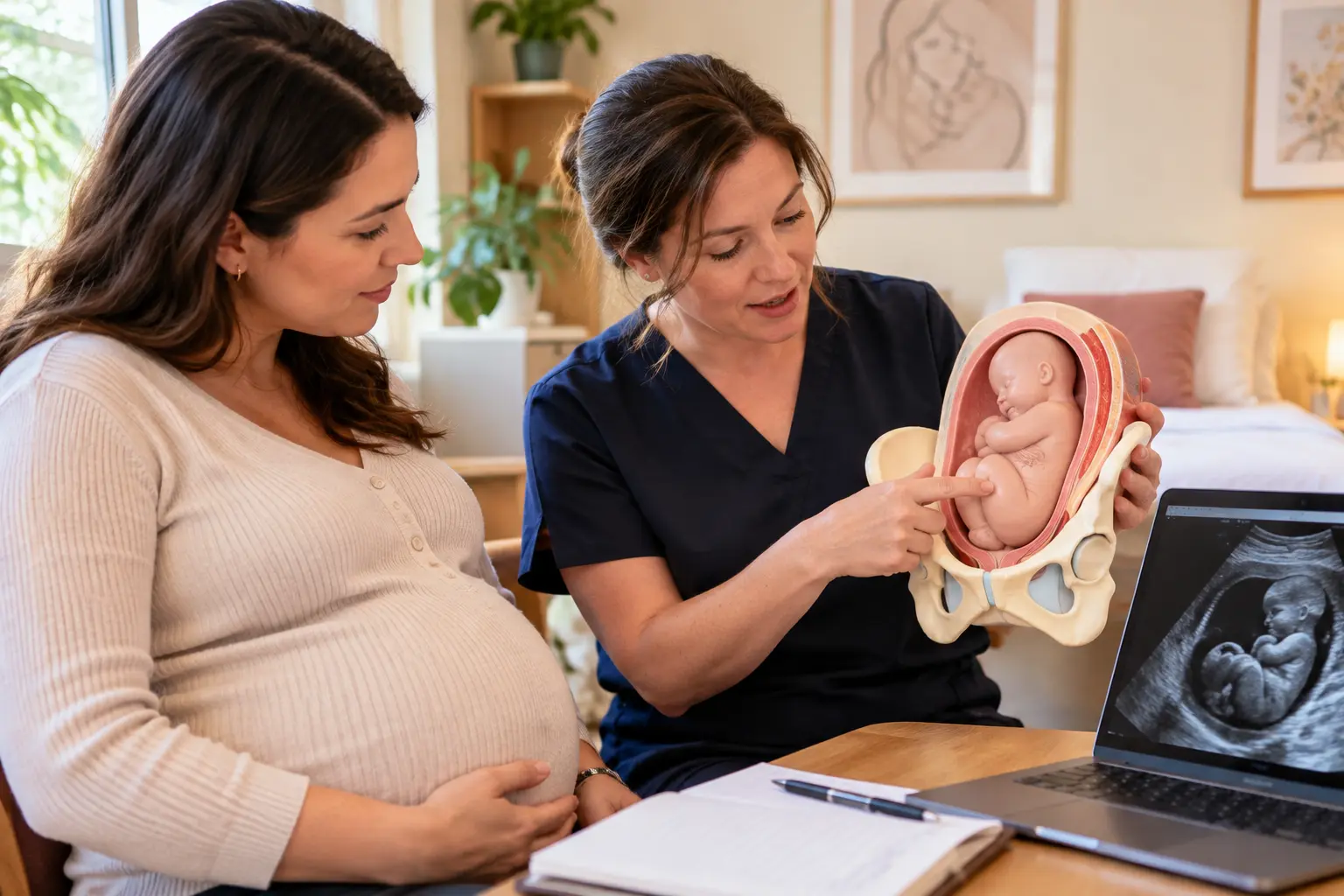
Your midwife or doctor can often tell which way your baby is lying by feeling specific points on your abdomen to find the head, back, and bottom. According to ACOG, an ultrasound or a pelvic exam may be used to confirm the position. If you are curious how ultrasound fits into routine care, our guide to ultrasound and other prenatal tests explains what is typically offered and when.
Can a Breech Baby Still Turn?
Yes, many do. RCOG says breech is very common in early pregnancy and that by 36 to 37 weeks most babies turn into the head-first position on their own. That is why a breech position found earlier in pregnancy is usually not a cause for concern by itself.
No one can reliably predict whether a particular baby will turn, and published guidance does not give a dependable chance of turning for each week. What guidance does describe is the general timeline below.
| When | What usually happens |
|---|---|
| Before 36 weeks | Breech is common, and most babies turn head down on their own by 36 to 37 weeks (RCOG). |
| Around 36 weeks | If your baby is still breech, your care team discusses your options. ACOG says ECV may be suggested once a pregnancy is past 36 weeks, and RCOG says it is usually offered at around 36 or 37 weeks. |
| 37 weeks and later | ECV can still be tried, right up until the early stages of labor (RCOG). ACOG notes it tends to be harder closer to birth, because a growing baby has less room to move. |
| If labor starts first | If you go into labor before a planned cesarean, you will be examined to see whether it is safe to go ahead. If the baby is close to being born, a vaginal breech birth may be safer (RCOG, NHS). |
Questions About Your Baby's Position?
Talk With Our Team
If you have questions about birth center care and how changes late in pregnancy are handled, the Birthing Center NYC team is here to help.
Contact UsWhat Is an External Cephalic Version (ECV)?
External cephalic version, usually shortened to ECV, is an attempt to turn a breech baby head down by applying pressure with the hands on the outside of the abdomen. ACOG says ECV can improve the chance of a vaginal birth. A Cochrane review of randomized trials found that attempting ECV at or near term lowered the chance of a baby being breech at birth and lowered the chance of cesarean birth, compared with not attempting it.
ACOG recommends that obstetric providers offer ECV to people who have a single breech baby at term, want to plan a vaginal birth, and have no reason the procedure should be avoided.
How ECV Is Done and Where
During an ECV, the provider places their hands on your abdomen and applies firm pressure so the baby rolls into a head-down position. Sometimes two people are needed, and ultrasound may be used to guide the turn. Your baby's heart rate is checked before and after the procedure, and ACOG says the attempt is stopped right away if any problems arise for you or the baby.
ECV is done near a delivery room, in a setting where cesarean birth is readily available, so that a cesarean can be performed quickly if it becomes necessary. RCOG adds that your pulse and blood pressure are checked beforehand and that, after a successful ECV, you can usually go home the same day.
If your blood type is Rh negative, ACOG's guidance says you should generally receive Rh immune globulin after an ECV attempt, whether or not the baby turns. Your care team can explain whether this applies to you.
How Often ECV Works
ACOG says more than half of ECV attempts succeed, and RCOG puts the success rate at about 1 in 2. RCOG notes that ECV is more likely to work if you have given birth vaginally before. If the first attempt doesn't work, it can sometimes be tried again on another day.
Some babies turn back into a breech position after a successful ECV. RCOG says this happens to fewer than 5 in 100 people.
Some hospitals use medication to relax the uterus, or an epidural or spinal anesthetic, during ECV. Research reviewed by ACOG and Cochrane shows these approaches can improve the chance of success. Whether they are used depends on the hospital and your situation.
Risks and Discomfort
ECV can be uncomfortable, and some people find it painful. RCOG says the provider will stop if you are in pain. Possible complications listed by ACOG include:
- The water breaking before labor (prelabor rupture of membranes)
- Changes in the baby's heart rate
- The placenta separating from the wall of the uterus (placental abruption)
- Preterm labor
RCOG describes ECV as generally safe with a very low complication rate, and it estimates a 1 in 200 chance of needing an emergency cesarean right after the procedure because of bleeding from the placenta or changes in the baby's heartbeat.
After An ECV
RCOG advises contacting your hospital or care team if you have any of the following after an ECV:
- Bleeding
- Abdominal pain
- Contractions
- Changes in your baby's movements
When ECV May Not Be an Option
ACOG and RCOG list situations where ECV is not attempted, including:
- Carrying more than one baby
- Concerns about the baby's health, such as an abnormal heart rate tracing
- Certain differences in the shape of the uterus or reproductive organs
- Placenta previa, or the placenta separating from the uterus
- Recent vaginal bleeding
- Waters that have already broken
- Needing a cesarean birth for another reason
A previous cesarean does not automatically rule out ECV. Both ACOG and RCOG say it can be considered after one cesarean birth. Your obstetric or midwifery team can assess whether ECV is appropriate for your pregnancy.
What Happens If Your Baby Stays Breech?
If ECV isn't possible, isn't successful, or isn't something you want, your care team will talk with you about how to plan the birth. ACOG and RCOG describe two main options, and both carry risks. Your team can explain how those risks apply to your situation.
Planned Cesarean Birth
ACOG says most breech babies are born by planned cesarean. The largest randomized trial on the question, the Term Breech Trial, found that serious problems or death for the baby around the time of birth were less common with planned cesarean than with planned vaginal birth (1.6% compared with 5.0%). ACOG notes that follow-up research has added nuance, including a two-year follow-up of the trial that found no difference between the groups in death or developmental delay.
RCOG summarizes the short-term risk this way: the chance of a breech baby dying is about 1 in 2,000 with a planned cesarean and about 4 in 2,000 with a planned vaginal breech birth, compared with about 2 in 2,000 for a planned vaginal birth when the baby is head down.
A cesarean is still major surgery. ACOG lists possible complications such as infection, bleeding, injury to internal organs, and problems related to anesthesia. A cesarean can also lead to complications in future pregnancies, including problems with the placenta and rupture of the uterus, and these risks increase with each cesarean.
Planned Vaginal Breech Birth in Selected Situations
ACOG says a planned vaginal birth of a single breech baby at term may be reasonable under hospital-specific guidelines for who is eligible and how labor is managed. The experience of the provider matters, and ACOG notes that fewer clinicians in the United States now have the skills to attend vaginal breech births. If this option is planned, ACOG calls for a detailed informed consent discussion that includes the possibility of higher short-term risks for the baby than with a planned cesarean.
RCOG advises planning a vaginal breech birth in a hospital with a team trained in breech birth and the ability to perform an emergency cesarean, because about 4 in 10 people planning a vaginal breech birth end up needing a cesarean. Induction of labor is not usually recommended. ACOG explains why breech birth needs that level of care: the baby's head is born last, and there is a risk that the head or shoulders become stuck or that the umbilical cord slips down before the baby (cord prolapse).
RCOG says a care team may advise against a vaginal breech birth if:
- One or both of the baby's feet are below the bottom (footling breech)
- The baby is larger or smaller than average
- The baby's neck appears very tilted back on ultrasound
- You have a low-lying placenta (placenta previa)
- You have preeclampsia or other pregnancy complications
If Labor Starts Before a Planned Cesarean
Labor sometimes begins before a scheduled cesarean. RCOG and the NHS say that if this happens, your healthcare professional will examine you to see whether it is safe to proceed with the cesarean, and that if the baby is close to being born, a vaginal breech birth may be safer. If your baby is known to be breech, ask your care team ahead of time what to do and where to go if labor starts or your water breaks.
What Does a Breech Baby Mean for a Birth Center Birth?
For most families, a baby who stays breech near the end of pregnancy means planning a hospital birth instead of a birth center birth. This is a safety decision based on where the care a breech birth may need is available, not a judgment about you or your birth preferences.
Why Position Affects Birth Center Eligibility
Birth centers are designed for healthy, low-risk pregnancies. ACOG and the Society for Maternal-Fetal Medicine describe birth centers as providing care for "low-risk women with uncomplicated singleton term vertex pregnancies who are expected to have an uncomplicated birth." Vertex means head down.
The Commission for the Accreditation of Birth Centers (CABC), which accredited Birthing Center NYC in July 2026, explains that breech births are linked to a higher risk of complications needing interventions that are only available in a hospital obstetric unit. For that reason, CABC says accredited birth centers transfer people who are known to have a baby in the breech position to a hospital. CABC adds that if the midwives have hospital privileges, a vaginal birth with the midwife may be possible.
New York's rules point the same way. Regulations for midwifery birth centers require the center to begin a transfer when risks are identified, including "when there may be an operative or cesarean birth." You can read more about how New York regulates birth centers in our guide to state licensing.
Research on community births supports this caution. A 2024 study of nearly 72,000 planned home and birth center births in the United States found that breech labors had much higher rates of hospital transfer and cesarean birth than head-down labors, along with higher rates of newborn complications such as NICU admission and cord prolapse.
Planning Your Care If Your Baby Stays Breech
Eligibility for a birth center birth isn't decided once. Your midwife reassesses it as your pregnancy progresses, and a breech position found late in pregnancy is one of the changes that can shift the plan. Our guide to who can give birth at a birth center explains how that screening works, and our comparison of how birth setting decisions differ covers why a breech baby generally moves the conversation toward a hospital in any out-of-hospital setting.
A change in birth setting doesn't have to mean starting over with a new team. Birthing Center NYC states that its midwives also attend planned hospital births at an affiliated hospital. You can learn more about planned hospital birth with your own midwives and ask your midwife how that care would work if your baby stays breech, including who would be involved in a cesarean or a vaginal breech birth.
A breech baby is one of several late-pregnancy changes that can affect your birth plan. Another is going past your due date, which also has its own limits for birth center care.
Planning Your Birth?
Talk Through Your Options
A consultation is a chance to ask how our midwives screen for eligibility, what happens when a pregnancy changes, and how hospital care is coordinated.
Schedule a ConsultationDo Exercises, Positions, or Other Methods Turn a Breech Baby?
It's natural to want to do something to help your baby turn, and there is a lot of advice online. Here is what the evidence shows.
- Positions and exercises: A Cochrane review of trials in which pregnant people rested with their pelvis raised, such as the knee-chest position, found no difference in breech births or cesarean rates. The review concluded there is insufficient evidence to support positions for turning a breech baby. RCOG says there is no scientific evidence that lying down or sitting in a particular position helps a baby turn.
- Moxibustion: This traditional Chinese medicine practice involves burning a dried herb (mugwort) near an acupuncture point on the little toe. A 2023 Cochrane review found moderate-certainty evidence that moxibustion added to usual care probably reduces the chance of a baby being breech at birth slightly, but it probably makes little or no difference to cesarean rates. In one study, some people reported side effects such as nausea, an unpleasant smell, abdominal pain, and contractions, although the review rated that evidence as very uncertain. RCOG says moxibustion at 33 to 35 weeks may help and should be done under the direction of a registered healthcare practitioner.
- Acupuncture combined with moxibustion: The same Cochrane review found very little evidence about this combination, and the certainty of the evidence was not assessed.
- Chiropractic care, including the Webster technique: Neither ACOG's nor RCOG's patient guidance includes chiropractic care as a way to turn a breech baby. The published research we found consists of case reports and patient satisfaction surveys, not controlled trials showing that it turns breech babies.
- Spinning Babies, inversions, music, and cold or warm packs: We did not find controlled trials showing that these turn breech babies. Programs built on positions fall under the same evidence gap as the positions above.
None of these methods replaces assessment by your care team. Talk with your midwife or doctor before trying any of them, so they can consider your pregnancy and your timing.
Questions to Ask Your Midwife or Obstetric Provider
- How did you confirm my baby's position, and will you check it again?
- Which type of breech position is my baby in?
- Is there anything about my pregnancy that could make turning harder?
- Am I a candidate for ECV, and when and where would it be done?
- What is the chance of success for me, and can it be tried more than once?
- What pain relief or medication might be offered during ECV?
- If my baby stays breech, what are the benefits and risks of a planned cesarean and of a planned vaginal breech birth for me?
- Does the hospital have clinicians experienced in vaginal breech birth?
- What should I do, and where should I go, if labor starts or my water breaks before the planned birth?
- If I can no longer give birth at the birth center, which parts of my care can stay with my midwives?
Frequently Asked Questions
Can a breech baby turn at 37, 38, or 39 weeks?
Guidance doesn't give a reliable chance of a baby turning on their own at any particular week. RCOG says most babies turn head down by 36 to 37 weeks, and that ECV can be tried up until early labor. ACOG notes that turning becomes harder closer to birth because the baby has less room. Your care team will confirm your baby's position before any procedure or birth plan is finalized.
When do babies usually turn head down?
Most babies are head down by 36 to 37 weeks of pregnancy, according to RCOG. By the end of pregnancy, only about 3 to 4 in every 100 babies are breech.
What happens if my baby is breech at 36 weeks?
At around 36 weeks, your care team will discuss your options: trying ECV, planning a cesarean birth, or, in selected situations, planning a vaginal breech birth in a hospital. If you were planning a birth center birth, your midwife will also talk with you about how the breech position affects where you give birth.
Is ECV painful?
It can be. RCOG says ECV can be uncomfortable and sometimes painful, that the experience differs from person to person, and that the provider will stop if you are in pain. Some hospitals offer medication or regional anesthesia that can also improve the chance of success.
Is ECV safe, and can it harm my baby?
ECV is generally considered safe when done in a hospital setting with monitoring. In randomized trials reviewed by Cochrane, babies in the ECV groups did not have more low Apgar scores, neonatal admissions, or deaths around the time of birth than babies in the comparison groups, although the trials were small and the review graded the evidence as low or very low certainty. Cochrane notes that large observational studies suggest complications are rare, and RCOG says there does not appear to be an increased overall risk to the baby. Serious complications, such as placental abruption or heart rate changes, are the reason ECV is done where an emergency cesarean is available.
Does a breech baby automatically mean a C-section?
No. Many breech babies turn on their own or with ECV. If a baby stays breech, most are born by planned cesarean, but ACOG and RCOG say a planned vaginal breech birth may be an option in selected situations, in a hospital with an experienced team.
Can you have a breech baby at a birth center?
Generally, no. CABC says accredited birth centers transfer people who are known to have a breech baby to a hospital obstetric unit, and New York's midwifery birth center rules require a transfer when a cesarean birth may be needed. Talk with your midwife about what this means for your plan.
How can you tell if your baby is breech?
Your midwife or doctor checks your baby's position during prenatal visits by feeling your abdomen, and can confirm it with an ultrasound or a pelvic exam. If you are unsure about your baby's position late in pregnancy, ask at your next visit.
Still Exploring Your Options?
Visit the Birth Center
See the space, meet the team, and ask your questions about eligibility, prenatal care, and planning for changes along the way.
Schedule a TourTaking the Next Step
If your baby is breech, you have time and options. Many babies turn on their own, ECV is available for many people, and when a baby stays breech, your care team can help you weigh a planned cesarean and, where appropriate, a planned vaginal breech birth. Bring your questions to your next appointment, and ask how your care will continue if your birth setting needs to change.
Sources and References
- If Your Baby Is Breech. American College of Obstetricians and Gynecologists, FAQ079, last reviewed November 2024.
- Mode of Term Singleton Breech Delivery, Committee Opinion No. 745. American College of Obstetricians and Gynecologists, 2018, reaffirmed 2026.
- External Cephalic Version, Practice Bulletin No. 221. American College of Obstetricians and Gynecologists, 2020, reaffirmed 2026.
- Levels of Maternal Care, Obstetric Care Consensus No. 9. American College of Obstetricians and Gynecologists and Society for Maternal-Fetal Medicine.
- Breech baby at the end of pregnancy. Royal College of Obstetricians and Gynaecologists, updated July 2026.
- What happens if your baby is breech? NHS.
- Hofmeyr GJ, Kulier R, West HM. External cephalic version for breech presentation at term. Cochrane Database of Systematic Reviews, 2015.
- Cluver C, Gyte GM, Sinclair M, Dowswell T, Hofmeyr GJ. Interventions for helping to turn term breech babies to head first presentation when using external cephalic version. Cochrane Database of Systematic Reviews, 2015.
- Hofmeyr GJ, Kulier R. Cephalic version by postural management for breech presentation. Cochrane Database of Systematic Reviews, 2012.
- Coyle ME, Smith C, Peat B. Cephalic version by moxibustion for breech presentation. Cochrane Database of Systematic Reviews, 2023.
- Hannah ME, et al. Planned caesarean section versus planned vaginal birth for breech presentation at term: a randomised multicentre trial. The Lancet, 2000.
- Schafer R, Bovbjerg ML, Cheyney M, Phillippi JC. Maternal and neonatal outcomes associated with breech presentation in planned community (home and birth center) births in the United States. PLOS ONE, 2024.
- For Families and Find Accredited Birth Centers. Commission for the Accreditation of Birth Centers.
- 10 NYCRR 795.4, Midwifery birth center transfer procedures. New York State Department of Health regulations.
About the Author
Igel Cudiera
Igel Cudiera wrote this article for Birthing Center NYC. It draws on guidance from the American College of Obstetricians and Gynecologists, the Royal College of Obstetricians and Gynaecologists, the NHS, Cochrane systematic reviews, the Commission for the Accreditation of Birth Centers, New York State regulations, and the other sources listed above.
This content is intended for general educational purposes only and is not medical advice. It does not replace an assessment by your midwife or doctor. If you have questions about your baby's position or your birth plan, talk with your health care provider.